
Energy Systems Twins How can the power grid of the future be monitored and controlled? Operation?
Control systems are a central element for controlling critical infrastructures, in particular energy supply systems. They have grown historically, are monolithic, proprietary and generally antiquated in their appearance and handling, and they demand great expertise from operating personnel, with lengthy qualification paths.
All of this is problematic in light of the numerous challenges posed by the energy transition. Decentralised generation by small and very small installations, including at lower voltage levels, leads to an enormous increase in complexity. Added to this is the growing need to couple both different energy sectors and, in connection with this, the IT systems in the background. These factors in turn make a high degree of automation and the introduction of new operational management approaches necessary, in particular innovative and possibly AI-based solutions. Accordingly, among grid operators there is an ambition to harmonise and couple control systems in order to increase efficiency and to open up the possibility of taking over grid operation for other, mostly small grid operators at defined times (e.g. night-time operation). However, this also increases the complexity for the operating personnel, who are already confronted with increasing critical grid states as well as rising threats from cyberattacks.
The historically grown control systems are reaching their limits both internally and externally. Owing to outdated software technologies and concepts, natural performance limits arise, among other things with regard to real-time capability as well as extensibility and maintainability. Control systems also reach their limits on the topic of IT security, since IT security was not yet a focus during their development and consequently has to be implemented in a cumbersome way. The harmonisation and coupling of control systems sought by grid operators is made largely to entirely impossible by vendor lock-in; the same applies to extending control systems with functionalities provided by third parties.
Furthermore, the expertise required to operate the control systems is confronted with a shortage of skilled personnel, which is further aggravated by the use of outdated software concepts. Skilled personnel trained today are taught modern software and interaction concepts. Accordingly, working with software that is outdated and that appears archaic in terms of human-machine interaction is not intuitive and is unattractive on the labour market.
In summary, the challenges posed by the energy transition in particular are all the harder to master with the current, antiquated control systems. For this reason, the TWO group researches the use of digital twins for monitoring and controlling energy systems, in short Energy Systems Twins (EST).
OFFIS defines digital twins in a domain-independent way as follows:
“A digital twin is the highest form of integration of the digital twin concept. It consists of a physical object and a digital object that maps the physical object in such detail that the purpose of the digital twin is fulfilled. The connection between the objects is bidirectional and takes place in real time. The digital object is updated by data from observers and reflects decisions back to the physical object, influencing the object by means of manipulators.”
The following characteristics can be highlighted in particular:
- Purpose-binding: the goal of every digital twin is to fulfil a previously defined purpose. The functional scope of the digital twin is sufficient as soon as the purpose can be fulfilled. A higher level of detail is possible but not necessary.
- Real time: the digital twin is bound in all its functionalities to the real-time requirement, i.e. within a predefined time span. How large this time span is follows from the purpose of the digital twin.
- Observers and manipulators: the digital object receives the data of the physical object by means of observers and in turn influences the physical object by means of manipulators. These can be, for example, sensors and actuators that automatically transmit the data and carry out tasks. The more broadly defined terms of observers and manipulators, however, also enable more far-reaching possibilities for data acquisition and the performance of work. For example, external systems not belonging to the physical object, as well as humans (human-in-the-loop), can contribute to data acquisition, as long as the real-time requirements permit this.
A major advantage of the definition is the mapping of passive physical objects (objects with insufficient sensor technology) by a digital twin. A schematic representation of a digital twin derived from the definition is shown in the figure.
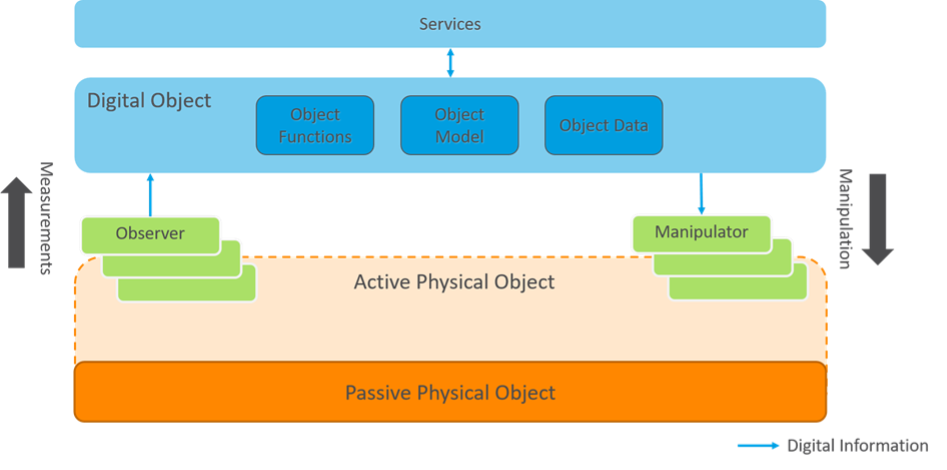
The concept of digital twins is suitable insofar as it goes beyond – potentially hierarchical or nested – digital representations and provides for an automated adaptation of the physical infrastructure on the basis of changes in the digital twin. The representation and modification of the physical infrastructure should, as far as possible, happen in real time. This real-time capability is realised through the use of data stream processing, which makes it possible to process, analyse and display data in an event-driven manner.
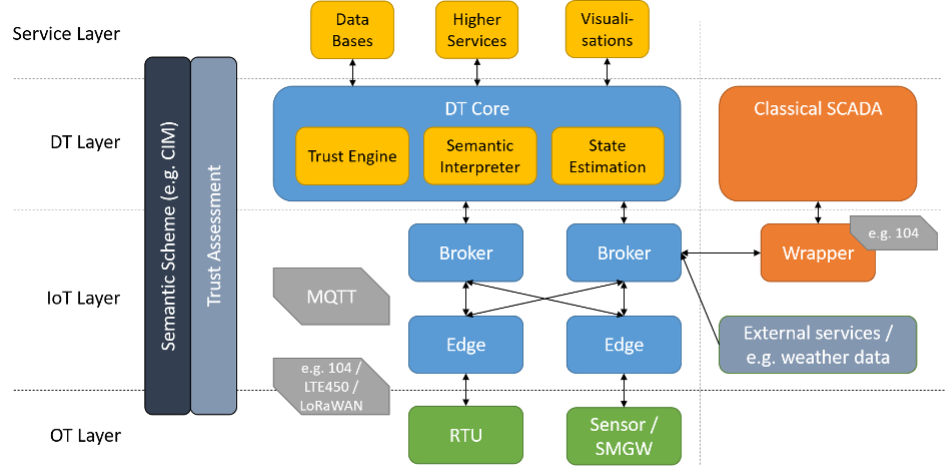
A further essential feature of EST is the possibility of holistic modelling of (coupled) energy and ICT systems. In particular, their interactions will be essential for resilient grid operation. Moreover, the increasing interaction between the control system and external actors and installations requires interoperability as a central goal, in order to be able to connect third-party processes and applications to the control system. Specifically, this requires defined interfaces that create the basis for modular exchange and extensibility.
Research Questions
The TWO group focuses, among other things, on the following research questions:
- How can ESTs be designed so that they address current and future challenges of IoT-based CPESs?
- How can CPES services be (re)designed by making use of the EST functions?
- How can HMIs for grid control be designed so that they are intuitive and purpose-oriented and can be generated automatically as far as possible?
Persons
Projects
Publications
- Management of Topological Data in Modular Energy Management Systems
- Next Generation Grid Control: A Modular and Scalable Event-Driven Architecture for Monitoring and Control of Power Systems
- OpenEnergyTwin-Open, Interoperable and User-Centered Platform for Sustainable Energy Systems
- Poster Abstract: Management of Topological Data in Modular Energy Management Systems
Persons 
B

L
O
P
R
W
Projects
2026

DPP4Energy
DPP4.0-Based Digitization of Product Groups, Facilities, and Processes in the Energy Industry
Duration: 2026 - 2028 IKTres
Preventive and corrective measures to mitigate communication disruptions and failures for a resilient, active, and digitized distribution network
Duration: 2026 - 20292025
VITAL
Verteilte Infrastrukturen für Technologie-Gestützte Innovationen im Verteilnetz
Duration: 2025 - 20262021
2020
ReMoDigital
Resilience Monitoring for the Digitization of the Energy Transition
Duration: 2020 - 2024 VORAUS PV
Entwicklung von Vorehrsagealgorithmen für Ausfälle in komplexen leistungselektronischen Systemen in der Photovoltaik
Duration: 2020 - 2023 SiNED
Systemdienstleistungen für sichere Stromnetze in Zeiten fortschreitender Energiewende und digitaler Transformation
Duration: 2020 - 2024 Publications
2026

hyBit Open Data Collection: FAIR Data for Hydrogen-Based Industrial Transformation
Danila Valko and Sharaf Alsharif and Kaja Petersen and Jorge Marx Gómez; Proc. of the 3nd ICTA-EMOS conference (ICTA-EMOS 2026); August / 2026
Resilience of Digitalized Power Systems-Challenges and Solutions
Brand, Michael and Stark, Sanja and Holly, Stefanie and Kamsamrong, Jirapa and Mayer, Christoph and Lehnhoff, Sebastian; Towards Energy System Resilience; 2026
Shaping and Monitoring Resilient Energy Systems—A Synthesis
van Doren, Davy and Droste-Franke, Bert and Brand, Michael and Derendorf, Karen and Fohr, Gabriele and Gils, Hans Christian and Kaiser, Matthias and Knieling, Jörg and Lehnhoff, Sebastian and von Maydell, Karsten and others; Towards Energy System Resilience; 2026
2025
Management of Topological Data in Modular Energy Management Systems
Blümel, Kersten and Brand, Michael and Lehnhoff, Sebastian; 2025 IEEE PES Innovative Smart Grid Technologies Conference Europe (ISGT Europe); Oct / 2025
Next Generation Grid Control: A Modular and Scalable Event-Driven Architecture for Monitoring and Control of Power Systems
Brand, Michael and Blümel, Kersten and Bruhn, Jan-Henrik and Fatemi, Armin and Huxoll, Nils and Lehnhoff, Sebastian; 2025 IEEE Kiel PowerTech; 2025
OpenEnergyTwin-Open, Interoperable and User-Centered Platform for Sustainable Energy Systems
Brand, Michael and Bruhn, Jan Henrik and Huxoll, Nils and Schmidtke, Florian and Wirtz, Nikolaus and Andres, Michael and Fatemi, Armin and Selimaj, Antigona and Ulbig, Andreas and Lehnhoff, Sebastian; ETG Kongress 2025; Voller Energie-heute und morgen.; 2025
Poster Abstract: A Digital Twin Platform Applied to Hydrogen Electrolyzers
Amit Kumar Singh, Jelke Wibbeke, Amin Raeiszahdeh, Nils Huxoll, Michael Brand; DACH+ Conference on Energy Informatics 2024; February / 2025
Poster Abstract: Management of Topological Data in Modular Energy Management Systems
Kersten Blümel, Michael Brand, Sebastian Lehnhoff; Energy Informatics Review, Volume 3, Issue 3, September 2025; September / 2025
Resilience Monitoring for the Digitalisation of the Energy Transition (ReMoDigital)
Bert Droste-Franke and Gabriele Fohr and Davy van Doren and Markus Voge and Moritz Bergfeld and Urte Brand-Daniels and Karen Derendorf and Marc Dziakowski and Hans Christian Gils and Ghinwa Harb and Gandhi Pragada and Tudor Mocanu and Sophie Nägele and Henrik Netz and Martin Plener and Angelika Schulz and Henning Wigger and Madhura Yeligeti and Michael Brand and Batoul Hage Hassan and Anand Narayan and Sigrid Prehofer; January / 2025
2024
Applying Trust for Operational States of ICT-Enabled Power Grid Services
Michael Brand, Anand Narayan, Sebastian Lehnhoff; April / 2024
