
Trustworthy System Operation Trustworthy System Operation focuses on the question of the extent to which a widely distributed and complex cyber-physical energy system can be trusted to fulfil its task of supplying all consumers with energy. The two group (Trustworthy System Operation) researches trust concepts and methods and combines them with digital twins of energy systems for trustworthy and resilient system operation.
A profound paradigm shift has begun in the energy sector – driven above all by the extensive integration of distributed energy resources, the liberalisation of energy markets, and the changing roles of actors, for example towards prosumers. In order to continue monitoring and controlling energy systems, they are being increasingly permeated with information and communication technologies as well as automation technologies. However, this also increases the complexity of the system and makes it more vulnerable to cyberattacks.
Monitoring and controlling such a widely distributed, complex and dynamic cyber-physical energy system can be broken down into a simple – but not simply answered – question:
To what extent can the energy system be trusted to supply all consumers with energy?
This trust has always been composed of “computational trust” and the individual trust of control-room personnel, traditionally paired with an element of blind trust. Measurement values are acquired and blindly trusted, system states and situational pictures are computed (computational trust) and interpreted on the basis of the experience and expertise of the control-room personnel. However, when it comes to ensuring trustworthy and resilient system operation amid the increase in complexity and the new attack surfaces for cyberattacks described above, this approach reaches its limits.
A key challenge here is to extend computational trust to the entire cyber-physical energy system – in particular to the information and communication technologies as well as the automation technologies – and thereby eliminate blind trust. Meeting this challenge requires flexible, purpose-oriented, digital real-time twins of cyber-physical energy systems.
Following this vision, the key topics of the TWO group are the following:
- Trust: How can the trustworthiness of cyber-physical systems be systematically assessed in order to enable more trustworthy and resilient system operation?
- Energy Systems Twins: How can digital twins help to address the challenges in the day-to-day operation of cyber-physical energy systems?
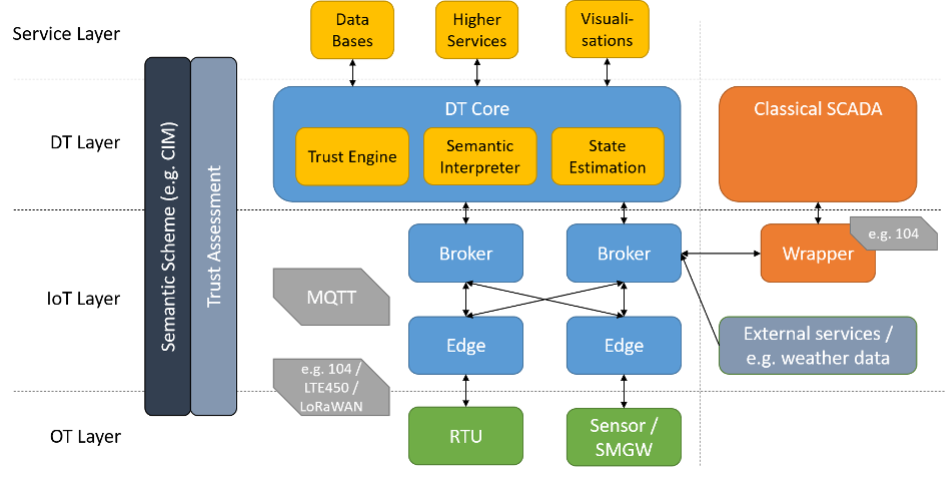
Taken together, the research within these key topics aims at a new, innovative system architecture that enables complex cyber-physical systems to be monitored and controlled resiliently. In doing so, established standards from the domain, such as the Common Information Model (CIM), are combined with established standards from other domains, such as MQTT, and with new concepts, such as trust assessment and hierarchically nested digital twins, to form a modular, highly flexible and resilient system.
Research Topics

Trust
Trust is a subjective, context-dependent and multivariate perception of an entity with respect to diverse aspects. It enables broader monitoring of components, data and services. In doing so, trust opens up new possibilities for capturing complex events and, building on this, for decision-making. Learn more…

Energy Systems Twins
Rising volatility and complexity in energy systems call for new concepts and system architectures to monitor and control energy systems efficiently. Digital twins are dynamic virtual copies of real existing systems. Originally emerging from product lifecycle management, digital twins are now opening up diverse new applications in the energy domain as well. Learn more…

Persons 
B

L
O
P
R
W
Projects
2026

DPP4Energy
DPP4.0-Based Digitization of Product Groups, Facilities, and Processes in the Energy Industry
Duration: 2026 - 2028 IKTres
Preventive and corrective measures to mitigate communication disruptions and failures for a resilient, active, and digitized distribution network
Duration: 2026 - 20292025
VITAL
Verteilte Infrastrukturen für Technologie-Gestützte Innovationen im Verteilnetz
Duration: 2025 - 20262021
2020
ReMoDigital
Resilience Monitoring for the Digitization of the Energy Transition
Duration: 2020 - 2024 VORAUS PV
Entwicklung von Vorehrsagealgorithmen für Ausfälle in komplexen leistungselektronischen Systemen in der Photovoltaik
Duration: 2020 - 2023 SiNED
Systemdienstleistungen für sichere Stromnetze in Zeiten fortschreitender Energiewende und digitaler Transformation
Duration: 2020 - 2024 Publications
2027

HyBiEn: Hybrid Bipolar Ensembles for Imbalanced Regression
Wibbeke, Jelke and Ribeiro, Rita P. and Rohjans, Sebastian and Rauh, Andreas; Discovery Science; 2027
2026
Evaluating the quality of the quantified uncertainty for (Re)calibration of data-driven regression models
Jelke Wibbeke and Nico Schönfisch and Sebastian Rohjans and Andreas Rauh; International Journal of Approximate Reasoning; 2026
hyBit Open Data Collection: FAIR Data for Hydrogen-Based Industrial Transformation
Danila Valko and Sharaf Alsharif and Kaja Petersen and Jorge Marx Gómez; Proc. of the 3nd ICTA-EMOS conference (ICTA-EMOS 2026); August / 2026
Resilience of Digitalized Power Systems-Challenges and Solutions
Brand, Michael and Stark, Sanja and Holly, Stefanie and Kamsamrong, Jirapa and Mayer, Christoph and Lehnhoff, Sebastian; Towards Energy System Resilience; 2026
Shaping and Monitoring Resilient Energy Systems—A Synthesis
van Doren, Davy and Droste-Franke, Bert and Brand, Michael and Derendorf, Karen and Fohr, Gabriele and Gils, Hans Christian and Kaiser, Matthias and Knieling, Jörg and Lehnhoff, Sebastian and von Maydell, Karsten and others; Towards Energy System Resilience; 2026
2025
Management of Topological Data in Modular Energy Management Systems
Blümel, Kersten and Brand, Michael and Lehnhoff, Sebastian; 2025 IEEE PES Innovative Smart Grid Technologies Conference Europe (ISGT Europe); Oct / 2025
Model-agnostic Mitigation Strategies of Data Imbalance for Regression
Wibbeke, Jelke and Rohjans, Sebastian and Rauh, Andreas; 2025
Next Generation Grid Control: A Modular and Scalable Event-Driven Architecture for Monitoring and Control of Power Systems
Brand, Michael and Blümel, Kersten and Bruhn, Jan-Henrik and Fatemi, Armin and Huxoll, Nils and Lehnhoff, Sebastian; 2025 IEEE Kiel PowerTech; 2025
OpenEnergyTwin-Open, Interoperable and User-Centered Platform for Sustainable Energy Systems
Brand, Michael and Bruhn, Jan Henrik and Huxoll, Nils and Schmidtke, Florian and Wirtz, Nikolaus and Andres, Michael and Fatemi, Armin and Selimaj, Antigona and Ulbig, Andreas and Lehnhoff, Sebastian; ETG Kongress 2025; Voller Energie-heute und morgen.; 2025
Poster Abstract: A Digital Twin Platform Applied to Hydrogen Electrolyzers
Amit Kumar Singh, Jelke Wibbeke, Amin Raeiszahdeh, Nils Huxoll, Michael Brand; DACH+ Conference on Energy Informatics 2024; February / 2025
