
Trust How can the trustworthiness of cyber-physical systems be systematically assessed in order to enable more trustworthy and resilient system operation?
The digitalisation of energy systems has given rise to cyber-physical energy systems (CPESs), which are characterised by an increased penetration of information and communication technologies (ICTs). ICT systems typically consist of hardware, software and data, all of which enable the secure and reliable operation of the connected energy system. This growing dependence on ICT systems has already increased the number of factors that influence the overall behaviour of the CPES. Past events have shown that, alongside traditional energy-system problems, ICT problems – such as software faults, overloads and cyber threats – can also lead to large-scale power outages. This highlights the need for holistic monitoring not only of the energy system but also of the connected ICT system, in order to detect events that can harm the entire CPES.
Trust in the Context of Cyber-Physical Energy Systems
Trust, a concept originally derived from the field of organic computing, is used to assess the trustworthiness of complex systems, subsystems and components. It is defined as a context-dependent and multivariate perception of an entity with respect to its capability, reliability and credibility. Trust can relate to components, data or services of the energy and ICT system as well as to the entire CPES.
Trust in an entity can be assessed on the basis of a combination of static information (e.g. from an information security management system (ISMS)), real-time information from monitoring systems (e.g. from an ICT health monitoring system or an intrusion detection system (IDS)), or on the basis of experience. Different pieces of information contribute to computing the various facets – capability, reliability and credibility. For example, an ICT health monitoring system can contribute to reliability, while an IDS contributes to credibility. The different facets make it possible to use trust to identify or anticipate a wide range of disturbances in CPESs, on the basis of which better operational decisions can be made.
Trust in components can also be used for holistic condition monitoring of the entire CPES, which considers not only traditional electrical-engineering parameters (e.g. power flows, currents) but also non-technical parameters (e.g. the performance of ICT components and network services). The hierarchical structure of an energy system also facilitates a hierarchical trust assessment. This is shown in the figure, in which the flow of electrical-engineering measurements is depicted across three different levels. At the process level, the sensors provide measurements such as active power (P), reactive power (Q) and currents (I). These measurements are then sent to an aggregator at the substation level, which collects the measurements from the sensors and sends the bundled measurements to a SCADA system at the control-centre level.
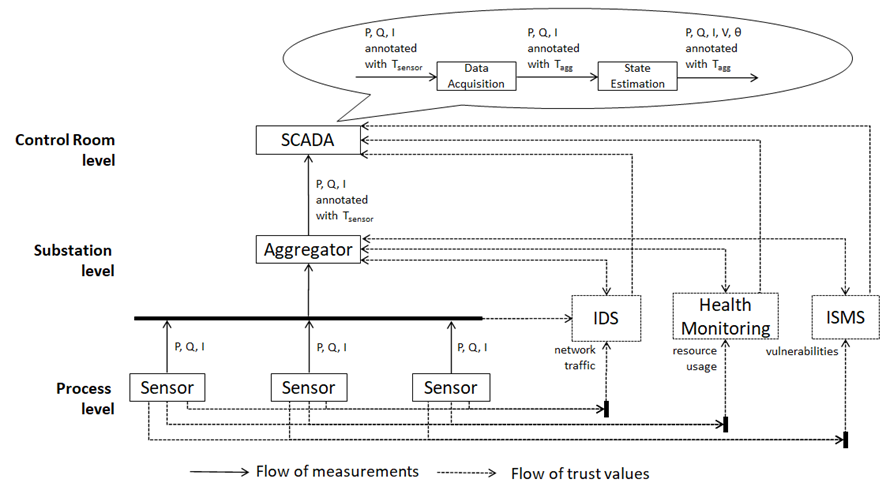
The first trust assessment of the sensors and their measurements is carried out at the aggregator using the information from an IDS, an ISMS and an ICT health monitoring system. The result is that the trust data transmitted to the SCADA system represents a multivariate value that can capture various disturbances such as cyberattacks and software/hardware malfunctions. A second trust assessment is performed in the SCADA system, taking into account the trust in the aggregator. This is done based on inputs from the same trust sources, which can monitor the aggregator in addition to the sensors. Since the measurements flow from the sensors via the aggregator, the trust in the aggregator also encompasses the trust in the sensors. This leads to a propagation of trust across the various components in the CPES. The result of the trust assessment can then be integrated into the services running in the SCADA control room (e.g. state estimation), leading to better situational awareness and better operational decisions in CPESs. A demonstration of trust assessment for energy and ICT systems considering state estimation can be found at https://youtu.be/3hwi49sfllQ.
The main benefits of using trust in CPESs can be summarized as follows:
- Improved situational awareness: trust and its facets provide a holistic model for monitoring energy and ICT systems, taking into account the underlying components and data.
- Anticipation and detection of disturbances: the trust facets can both capture and predict a wide range of disturbances in energy and ICT systems.
- Better decision-making: the trustworthiness of components and data, when integrated into the control of CPESs, can enable improved decision-making that considers not only the measurement values but also their trustworthiness.
Research Questions
In this context, the TWO group focuses, among other things, on the following research questions:
- How can trust in components and services in CPESs be assessed and this information be integrated into control-room applications or digital twins?
- How can the propagation of trust across various components and services in complex CPESs be modelled and analysed?
- How can complex multivariate trust values be interpreted semantically?
Persons
Projects
Publications
- Resilience of Digitalized Power Systems-Challenges and Solutions
- Shaping and Monitoring Resilient Energy Systems—A Synthesis
- Resilience Monitoring for the Digitalisation of the Energy Transition (ReMoDigital)
- Applying Trust for Operational States of ICT-Enabled Power Grid Services
- Modelling the propagation of properties across services in cyber-physical energy systems
- ASSESS – Anomaliesensitive State Estimation mit Streaming Systemen in Smart Grids
- Assess: anomaly sensitive state estimation with streaming systems
- Demo abstract: A Platform to Assess the Trust in Power System Components, Data, and Services
- Trust in Power System State Variables based on Trust in Measurements
- Framework for the Integration of ICT-relevant Data in Power System Applications
Persons 
B

L
O
P
R
W
Projects
2026

DPP4Energy
DPP4.0-Based Digitization of Product Groups, Facilities, and Processes in the Energy Industry
Duration: 2026 - 2028 IKTres
Preventive and corrective measures to mitigate communication disruptions and failures for a resilient, active, and digitized distribution network
Duration: 2026 - 20292025
VITAL
Verteilte Infrastrukturen für Technologie-Gestützte Innovationen im Verteilnetz
Duration: 2025 - 20262021
2020
ReMoDigital
Resilience Monitoring for the Digitization of the Energy Transition
Duration: 2020 - 2024 VORAUS PV
Entwicklung von Vorehrsagealgorithmen für Ausfälle in komplexen leistungselektronischen Systemen in der Photovoltaik
Duration: 2020 - 2023 SiNED
Systemdienstleistungen für sichere Stromnetze in Zeiten fortschreitender Energiewende und digitaler Transformation
Duration: 2020 - 2024 Publications
2027

HyBiEn: Hybrid Bipolar Ensembles for Imbalanced Regression
Wibbeke, Jelke and Ribeiro, Rita P. and Rohjans, Sebastian and Rauh, Andreas; Discovery Science; 2027
2026
Evaluating the quality of the quantified uncertainty for (Re)calibration of data-driven regression models
Jelke Wibbeke and Nico Schönfisch and Sebastian Rohjans and Andreas Rauh; International Journal of Approximate Reasoning; 2026
hyBit Open Data Collection: FAIR Data for Hydrogen-Based Industrial Transformation
Danila Valko and Sharaf Alsharif and Kaja Petersen and Jorge Marx Gómez; Proc. of the 3nd ICTA-EMOS conference (ICTA-EMOS 2026); August / 2026
Resilience of Digitalized Power Systems-Challenges and Solutions
Brand, Michael and Stark, Sanja and Holly, Stefanie and Kamsamrong, Jirapa and Mayer, Christoph and Lehnhoff, Sebastian; Towards Energy System Resilience; 2026
Shaping and Monitoring Resilient Energy Systems—A Synthesis
van Doren, Davy and Droste-Franke, Bert and Brand, Michael and Derendorf, Karen and Fohr, Gabriele and Gils, Hans Christian and Kaiser, Matthias and Knieling, Jörg and Lehnhoff, Sebastian and von Maydell, Karsten and others; Towards Energy System Resilience; 2026
2025
Management of Topological Data in Modular Energy Management Systems
Blümel, Kersten and Brand, Michael and Lehnhoff, Sebastian; 2025 IEEE PES Innovative Smart Grid Technologies Conference Europe (ISGT Europe); Oct / 2025
Model-agnostic Mitigation Strategies of Data Imbalance for Regression
Wibbeke, Jelke and Rohjans, Sebastian and Rauh, Andreas; 2025
Next Generation Grid Control: A Modular and Scalable Event-Driven Architecture for Monitoring and Control of Power Systems
Brand, Michael and Blümel, Kersten and Bruhn, Jan-Henrik and Fatemi, Armin and Huxoll, Nils and Lehnhoff, Sebastian; 2025 IEEE Kiel PowerTech; 2025
OpenEnergyTwin-Open, Interoperable and User-Centered Platform for Sustainable Energy Systems
Brand, Michael and Bruhn, Jan Henrik and Huxoll, Nils and Schmidtke, Florian and Wirtz, Nikolaus and Andres, Michael and Fatemi, Armin and Selimaj, Antigona and Ulbig, Andreas and Lehnhoff, Sebastian; ETG Kongress 2025; Voller Energie-heute und morgen.; 2025
Poster Abstract: A Digital Twin Platform Applied to Hydrogen Electrolyzers
Amit Kumar Singh, Jelke Wibbeke, Amin Raeiszahdeh, Nils Huxoll, Michael Brand; DACH+ Conference on Energy Informatics 2024; February / 2025
